Before vs After Geopolitical Escalation: How Global Tensions Are Impacting IPO Markets, Investor Sentiment & SEBI Compliance
InsiderQ • Global Tensions • 15 min read
- IPO Market Before Geopolitical Escalation
- DRHP Filings Remain Strong Despite IPO Slowdown
- Equity Market Correction Also Impacted IPO Sentiment
- Why Investor Sentiment Has Changed in IPO Markets
- Why SME IPOs Are Facing Higher Volatility in 2026
- Key Challenges for Merchant Bankers & Compliance Teams
- Before vs After Geopolitical Escalation: IPO Market Shift
- Key Takeaways
Introduction
India’s IPO market is entering a very different phase in 2026.
While DRHP filings continue and companies remain interested in public listings, actual IPO fundraising activity has slowed due to geopolitical tensions, market volatility, valuation concerns, and changing investor sentiment.
But recent geopolitical tensions, uncertainty around the US-Iran situation, Middle East instability, inflation concerns, and broader market volatility have started changing investor behavior.
Today, investors are becoming far more selective.
Instead of blindly chasing IPO hype, the market is slowly shifting toward:
- Corporate governance
- SEBI compliance
- UPSI management
- Financial sustainability
- Disclosure transparency
- Risk management systems
This shift is becoming increasingly important for:
- Merchant bankers
- Company secretaries
- Compliance officers
- SME IPO advisors
- Listed companies
- Corporate governance teams
The IPO market is not inactive.
It is becoming more disciplined.
How Do Geopolitical Tensions Affect IPO Markets?
Geopolitical tensions affect IPO markets by increasing uncertainty, weakening investor sentiment, creating valuation pressure, and delaying IPO launches. During volatile periods, investors focus more on governance, compliance, profitability, and long-term sustainability before investing in new public offerings.
IPO Market Before Geopolitical Escalation
Before global tensions increased, IPO markets were operating in a highly optimistic environment.
The market was witnessing:
- Strong retail participation
- Heavy IPO oversubscription
- Premium valuations
- High SME IPO momentum
- Faster fundraising cycles
- Strong liquidity across capital markets
Investor psychology during this phase was mainly driven by:
- Listing gains
- Momentum investing
- Growth expectations
- Quick wealth creation opportunities
- High-risk appetite
During bullish cycles, even companies with moderate profitability were able to attract strong IPO demand because market sentiment remained highly positive.
In many cases, liquidity itself was driving valuations faster than business fundamentals.
IPO Fundraising Slowdown Is Now Visible in Real Numbers
The impact of geopolitical tensions is now clearly visible in India’s IPO market data.
According to recent market reports, IPO fundraising activity declined significantly during Jan–May 2026 compared to the same period last year.
| Metric | Jan–May 2025 | Jan–May 2026 |
|---|---|---|
| IPO Funds Raised | ₹82,678 crore | ₹56,322 crore |
| Market Sentiment | Aggressive | Defensive |
| Fundraising Trend | Strong momentum | 32% decline |
| Market Environment | Liquidity-driven | Volatility & valuation pressure |
This slowdown reflects growing investor caution because of:
- Market volatility
- Middle East tensions
- US-Iran uncertainty
- FII outflows
- Inflation pressure
- Global economic uncertainty
- IPO valuation pressure
Market Observation
Investors are no longer rewarding every IPO equally.
Markets are becoming far more selective about governance quality, profitability visibility, and compliance discipline.
DRHP Filings Remain Strong Despite IPO Slowdown
One of the most interesting trends in 2026 is that DRHP filings continue to remain active even though actual IPO fundraising activity has slowed down.
Recent market reports indicate that March 2026 alone witnessed around 38 DRHP filings, showing that companies are still actively preparing IPO pipelines despite volatile market conditions.
At the same time, many issuers are becoming cautious about actual IPO launches because of:
- Market volatility
- Geopolitical tensions
- FII outflows
- Valuation pressure
- Weak investor sentiment
This clearly shows that companies still want to access public markets, but IPO timing has become extremely sensitive in the current environment.
Market Observation
The IPO pipeline remains active, but execution has become more selective.
Investors are no longer rewarding every IPO equally. Markets are becoming far more focused on governance quality, compliance discipline, profitability visibility, and long-term sustainability.
How Middle East Tensions & US-Iran Uncertainty Are Affecting IPO Markets
The ongoing Middle East tensions and uncertainty around the US-Iran situation are increasing pressure on global financial markets.
Whenever geopolitical instability rises in oil-sensitive regions, investors immediately become cautious because markets fear:
- Crude oil price spikes
- Inflation pressure
- Currency fluctuations
- Supply chain disruptions
- Weak global demand
- Foreign investor outflows
This directly affects IPO markets because institutional investors reduce exposure toward high-risk assets during uncertain conditions.
As a result:
- IPO launches slow down
- Investor participation weakens
- Valuation expectations reduce
- SME IPO volatility increases
Expert Insight
IPO markets dislike uncertainty more than bad news.
When global risks increase, investors become highly selective about governance quality, compliance maturity, and long-term sustainability.
Equity Market Correction Also Impacted IPO Sentiment
Broader market correction has also affected IPO momentum in 2026.
Recent market trends showed benchmark indices correcting nearly 9–12% during phases of heightened geopolitical uncertainty.
This naturally made investors more defensive toward:
New listingsAggressive valuationsHigh-risk SME IPOsMomentum-driven businesses
This environment increases pressure on IPO pricing, subscription demand, and listing performance.
Even Large Companies Are Becoming More Cautious
The impact of market uncertainty is not limited to SME IPOs.
Several large companies have also reportedly slowed or reassessed IPO timelines because of volatile market conditions and geopolitical uncertainty.
Reports suggested that PhonePe temporarily paused IPO planning discussions as market sentiment weakened amid valuation concerns and global instability.
This indicates that even fundamentally strong businesses are becoming more cautious about IPO timing.
Market Observation
In uncertain markets, timing can become as important as valuation.
Why Investor Sentiment Has Changed in IPO Markets
The biggest shift in 2026 IPO markets is investor behavior.
Earlier, investors focused heavily on:
- Listing gains
- Oversubscription hype
- Short-term momentum
Today, investors are asking different questions:
- Is the valuation justified?
- Is governance strong?
- Is the business financially sustainable?
- Are compliance systems reliable?
- Is promoter credibility strong?
This transition is reshaping how IPOs are evaluated across both Mainboard and SME segments.
Why SME IPOs Are Facing Higher Volatility in 2026
The SME IPO market is witnessing higher pressure compared to previous years.
This is mainly because SME businesses often carry:
- Higher operational risk
- Lower liquidity
- Limited institutional participation
- Greater dependency on future growth assumptions
As investor confidence weakens, speculative participation in SME IPOs reduces faster.
This is increasing focus on:
- Corporate governance
- SEBI compliance
- Disclosure quality
- Merchant banker due diligence
- UPSI management
- Risk management systems
Oversubscription alone is no longer enough to build investor confidence.
Markets are rewarding fundamentally stronger businesses instead of purely momentum-driven listings.
Why SEBI Compliance Matters More During Volatile IPO Markets
During uncertain market cycles, investors become highly sensitive toward governance failures and regulatory risks.
This is why SEBI compliance is becoming increasingly important in volatile IPO environments.
Investors are closely monitoring:
- Insider trading compliance
- UPSI management
- Structured Digital Database maintenance
- Disclosure transparency
- Audit readiness
- Corporate governance practices
Today, trust itself has become a valuation factor.
Companies with stronger compliance frameworks are often viewed as lower-risk investment opportunities.
Key Challenges for Merchant Bankers & Compliance Teams
Managing Investor Confidence
Merchant bankers are no longer focused only on fundraising.
They are also managing investor trust and market perception.
Even small disclosure gaps can negatively affect IPO confidence during volatile periods.
Managing UPSI & Insider Trading Risks
IPO-related activities involve large volumes of Unpublished Price Sensitive Information (UPSI).
This increases the importance of:
- UPSI tracking
- Insider trading monitoring
- Digital audit trails
- Structured compliance workflows
- Access management systems
Strong compliance infrastructure is becoming critical for maintaining investor confidence.
Handling Regulatory Scrutiny
As market volatility increases, regulatory scrutiny also becomes stronger.
Compliance teams must ensure:
- Accurate disclosures
- Governance transparency
- Real-time compliance readiness
- Proper documentation
- Risk monitoring controls
Operational discipline is becoming a competitive advantage in capital markets.
How Compliance Technology Is Helping IPO Teams
Modern IPO environments require technology-driven compliance systems.
Manual processes are no longer enough for handling complex IPO compliance requirements.
Today, organizations are using compliance technology to:
- Track UPSI access
- Maintain Structured Digital Databases
- Automate compliance workflows
- Reduce insider trading risks
- Improve audit readiness
- Strengthen governance transparency
For IPO-focused companies, compliance technology is becoming a strategic necessity rather than just an operational tool.
Before vs After Geopolitical Escalation: IPO Market Shift
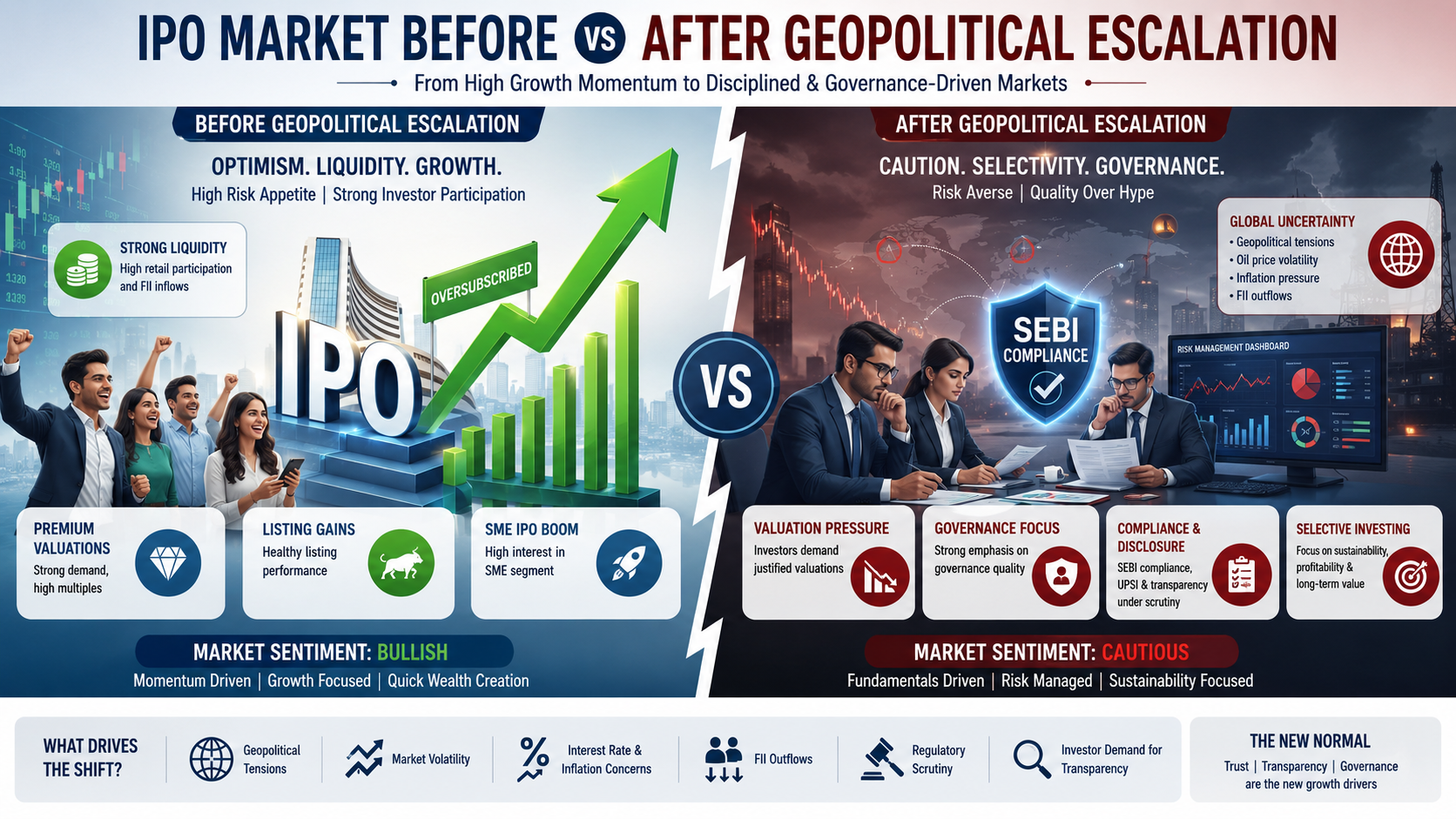
| Before Escalation | After Escalation |
|---|---|
| Aggressive IPO participation | Selective IPO participation |
| High-risk investing | Defensive investing |
| Premium valuations | Valuation pressure |
| Momentum-driven SME IPOs | Fundamentals-driven IPOs |
| Lower governance scrutiny | Higher compliance scrutiny |
| Liquidity-driven investing | Risk-managed investing |
| Listing gain focus | Sustainability focus |
Key Takeaways
- Geopolitical tensions are directly affecting IPO markets and investor sentiment.
- IPO fundraising activity slowed significantly in 2026 because of market volatility.
- DRHP filings remain active, but IPO execution has become more cautious.
- Middle East tensions and US-Iran uncertainty are impacting investor confidence globally.
- SME IPO markets are witnessing higher volatility and stronger scrutiny.
- Investors are prioritizing governance, sustainability, and compliance quality over hype.
- SEBI compliance and UPSI management are becoming major trust factors.
- Compliance technology helps reduce insider trading risks and improve transparency.
Final Thoughts
The IPO market in 2026 is evolving rapidly.
Earlier, markets rewarded aggressive growth stories and momentum-driven investing.
Today, investors are becoming more disciplined.
They want:
- Transparency
- Governance maturity
- Compliance readiness
- Sustainable business models
- Strong risk management systems
For merchant bankers, compliance officers, company secretaries, and IPO advisors, this shift creates both challenges and opportunities.
In volatile market environments, governance credibility can directly influence investor confidence, institutional participation, and long-term market reputation.
And going forward, companies with stronger compliance culture and operational transparency are likely to perform better in uncertain capital markets.