From Theory to Statute: How the Indian Government Actually Uses Blockchain in 2026
Naapbooks Insights • Hrms Migrations • 11 min read
- The Software Gets Blamed for Problems the Data Created
- The Five Data Problems That Quietly Break HRMS Migrations
- Field Mapping Is Where "Simple Migration" Gets Complicated
- The Parallel Payroll Run Is Not Optional
- Stop Asking "Is the New HRMS Ready?"
- The Contrarian Conclusion, Your Go-Live Is a Data Test
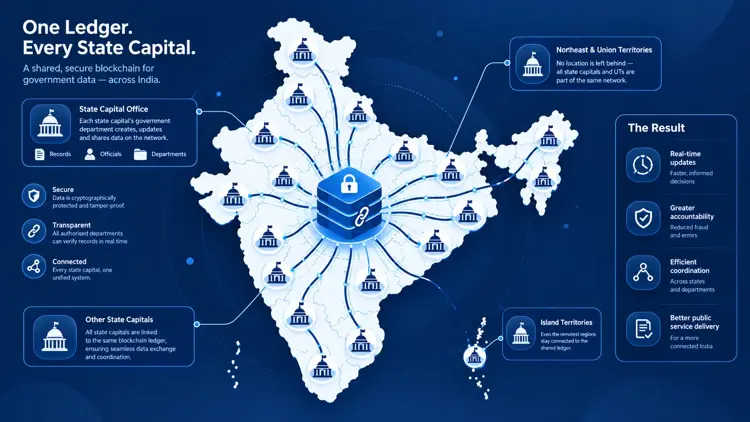
The Indian government uses blockchain mainly as a permissioned record-keeping layer: a shared ledger among known departments that makes official records harder to alter quietly and easier to verify later. This blockchain government India story is not a cryptocurrency programme, and so far it has not replaced any legal register. What exists in 2026 is a national platform run by MeitY, a set of state pilots led by land records, and an evidence law that decides whether a blockchain-backed record survives a challenge in court.
That last part is where "theory to statute" gets interesting. India has no standalone blockchain law that we could identify, so the technology works inside existing legislation. This article separates what is live from what is still a pilot, explains the legal footing, and shows how digital notarisation connects to it. If you work in a state department, a regulated business or a govtech team, you should finish knowing where e-governance blockchain fits and where it does not.
What has the government built for blockchain in e-governance?
Quick Answer: MeitY built a national, permissioned platform called the National Blockchain Framework. It gives departments ready-made Blockchain-as-a-Service infrastructure so they do not build networks from scratch.
The foundation is the National Blockchain Framework. MeitY's Secretary launched the Vishvasya Blockchain Technology Stack on 4 September 2024, offering Blockchain-as-a-Service on distributed infrastructure for permissioned applications, alongside NBFLite, a National Blockchain Portal and Praamaanik, a tool for verifying mobile app origin. The stack is hosted across NIC data centres in Bhubaneswar, Pune and Hyderabad.
Two terms matter. Permissioned blockchain means only known, authorised participants can write to the ledger, such as a revenue department, a registrar and an auditor. That suits government, where accountability matters more than anonymity. Blockchain-as-a-Service means a department does not assemble a network from scratch. MeitY cited the shortage of skilled manpower, vendor lock-in, and open research problems in security and interoperability as reasons for the framework. NBFLite is a lightweight sandbox for prototyping that supports Hyperledger Fabric and Hyperledger Sawtooth.
Picture an IT officer in a state that wants to pilot certificate verification. Without a shared stack, she must pick a vendor, a platform and a hosting model on her own. With one, she starts from a national base, and the framework describes ready-to-use, security-audited blockchain containers for production setups.
Which blockchain government India uses are live, and which are still pilots?
Quick Answer: Most are pilots or invitations to pilot. Andhra Pradesh's land records project is the most visible pilot, and the Blockchain India Challenge is a call for solutions, not a rollout.
Most e-governance blockchain work is at pilot stage. That is normal for public technology, but it is worth saying plainly.
| Initiative | Status | Key date |
|---|---|---|
| National Blockchain Framework (Vishvasya stack, NBFLite) | Launched platform | 4 September 2024 |
| Mee Bhoomi Blockchain (Andhra Pradesh land records) | Pilot | 23 July 2026 |
| Blockchain India Challenge (procurement, PDS, health, documents and more) | Call for pilots | 23 February 2026 |
Land records
Andhra Pradesh launched the Mee Bhoomi Blockchain pilot on 23 July 2026, aiming to bring land data from the revenue, survey and registration departments into one tamper-resistant system. The problem is familiar. A 2026 research paper notes that ownership records sit across offices such as the patwari, tehsildar, sub-registrar, survey and state revenue department, with no single source of truth. A farmer applying for a loan may need a bank to trust a record that several offices maintain separately.
The same paper calls proposals that make the chain a replacement for the statutory record legally premature. In practice, the ledger sits beside the legal register as an integrity layer.
Procurement, PDS, health and documents
MeitY launched the Blockchain India Challenge on 23 February 2026, implemented by C-DAC, inviting startups to build permissioned blockchain solutions for government. The listed domains include e-procurement, public distribution, health data integrity, supply chain and government document management, and submissions must be non-crypto and involve a government department.
A challenge is an invitation, not a rollout. Read it as a signal of where departments expect to partner, not proof these systems run at scale today.
Is there a blockchain law in India?
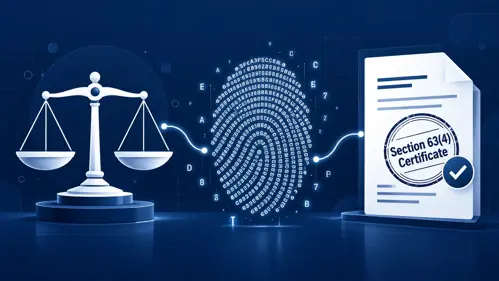
Quick Answer: Not a dedicated one that we could find. Blockchain records rely on the IT Act, 2000 and the Bharatiya Sakshya Adhiniyam, where the Section 63(4) certificate and hash value are central.
Blockchain-backed records lean on technology-neutral law. The IT Act, 2000 gives electronic records and digital signatures the same standing as paper and handwritten signatures under Sections 4 and 5, and Sections 61 to 63 of the Bharatiya Sakshya Adhiniyam recognise electronic records as evidence.
The BSA came into force on 1 July 2024, and its Section 63 succeeds Section 65B of the old Evidence Act, requiring certification by both the person in charge of the device and an expert. In 2026, the Supreme Court in Pune Bar Association v. Union of India upheld Section 63(4) and stressed that disclosing the hash value is not a mere technical formality. The Court described hash values as electronic fingerprints that help verify integrity.
Our interpretation: hashing is exactly what blockchains do, so the fit is natural. A ledger entry can carry the hash of a record, and a later mismatch reveals tampering. But the ledger does not remove the need for the certificate. Imagine a land dispute where a department produces a record from its system. The on-chain hash helps show the record is unchanged, yet the Section 63(4) certificate must still be filed correctly. Systems built without that process in mind end up secure but awkward in court. Confirm specifics with counsel.
What does digital notarisation have to do with government blockchain?
Quick Answer: Digital notarisation in India rests on the IT Act and BSA rather than a dedicated notarial procedure. Blockchain can anchor a notarised document's hash so it can be verified later, but it cannot prove who signed.
The Notaries Act, 1952 and Rules, 1956 predate digital communication, and the statute has no codified procedure for remote online notarisation, though the Ministry of Law and Justice runs a Notary Portal for digital practice certificates and renewals. Commentators note that the Delhi High Court has allowed an e-notarised document, but it is unclear whether this can become standard practice, and they call for guidelines by amendment. So digital notarisation currently rests on the IT Act and BSA rather than a dedicated notarial procedure.
Blockchain fits as an anchor. The hash and timestamp of a notarised document can be recorded on a ledger so anyone holding the file can later check that it is unchanged. The basic flow looks like this:
- The document is signed and notarised.
- A hash of the final file is generated.
- The hash and timestamp are anchored on the ledger.
- The recipient recomputes the hash and compares it with the ledger entry.
Consider an NRI who signs a power of attorney for a property matter. The bank or registrar receiving it wants to confirm the file is the one that was notarised. A hash check answers that in seconds.
The limit matters. Anchoring proves the file has not changed since that moment. It does not prove the signer was who they claimed or that the notary acted within authority. Those come from Aadhaar-based or certificate-based signing and the notary's own process. This is industry practice, not a statutory requirement.
What should a department or vendor settle before building?
Quick Answer: Decide what the chain proves, keep the statutory record as the source of truth, design for evidence, keep personal data off-chain, and plan integration with legacy registers.
- Decide what the chain proves. Integrity and timing, not the truth of the content.
- Keep the statutory record as the source. The ledger supports it.
- Design for evidence. Capture the hash, timestamp and process details a Section 63(4) certificate will need.
- Keep personal data off-chain. Store hashes and references, and respect data protection duties.
- Plan integration. A pilot that cannot talk to legacy registers stays a pilot.
The most common mistake is treating blockchain as a replacement for the system of record instead of a way to make it verifiable.
Audit-grade logging is a familiar demand in regulated software. Naapbooks' InsiderQ, for example, keeps time-stamped, non-tamperable logs for SEBI compliance, and the team builds blockchain applications for regulated environments. If you are weighing where a permissioned ledger fits in a records or compliance workflow, our overview of business blockchain solutions is a useful next read.