AI Is Not Magic: What Small Businesses Should Really Know

Naapbooks Insights • Artificial Intelligence • 5 min read
Quick Answer: AI doesn't create business value on its own. It amplifies whatever already exists in your business clean data and solid processes make AI powerful; messy data and weak processes make AI unreliable, no matter how advanced the model is.
Every few months, a new AI headline promises to change everything. ChatGPT, Claude, Copilot the names are now part of everyday business conversation. And it's easy to see why owners get excited. Who wouldn't want a tool that writes reports, answers customers, and crunches numbers in seconds?
But here's the catch almost nobody talks about: AI doesn't run on hype. It runs on data.
When a major AI model announcement rattled markets recently, Indian IT and software stocks reportedly lost close to ₹2 lakh crore in a single trading day. That's not the reaction you'd expect if AI were the guaranteed win everyone assumes it is. Markets don't panic over magic they panic over uncertainty, competition, and unproven returns.
So if you're a small or mid-sized business owner wondering whether AI is worth it, this article breaks down the myth, the reality, and where AI genuinely earns its keep.
The Big AI Myth
This is the single most common misconception among small business owners. AI is often marketed like a light switch: flip it on, and productivity, sales, or savings appear instantly.
In reality, AI systems are only as good as what feeds them. They don't invent insight from nothing they process the data and rules you give them.
AI does not create value automatically. It amplifies whatever system you already have good or bad.
That single idea explains almost every AI success story and every AI disappointment you'll come across. A business with clean records and defined workflows sees AI speed things up. A business with scattered spreadsheets and inconsistent processes sees AI produce confusing, unreliable, sometimes embarrassing results.
Common mistake: Buying an AI tool before fixing the data it will run on. This is the #1 reason AI projects stall or get abandoned within the first few months.
Why AI Doesn't Work Instantly?
Direct answer: AI needs structured, accurate, and consistent data to function well. Most small businesses don't have that yet which is why results feel slow or disappointing at first.
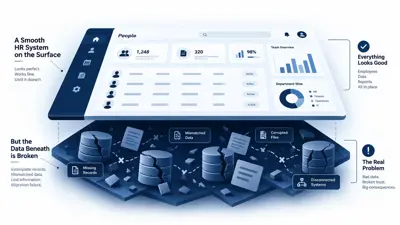
AI systems learn patterns from the information they're given. If that information is incomplete, duplicated, outdated, or scattered across ten different tools, the AI has nothing solid to learn from. The output reflects the input a principle often summed up as "garbage in, garbage out."
For most small and mid-sized enterprises (SMEs), the data that matters most usually includes:
- Customer and vendor records often duplicated across CRMs, spreadsheets, and email threads
- Invoices and accounting entries sometimes manual, inconsistent, or delayed
- Inventory and product data frequently outdated or tracked in disconnected systems
- Emails, documents, and reports unstructured and hard for any system (human or AI) to search
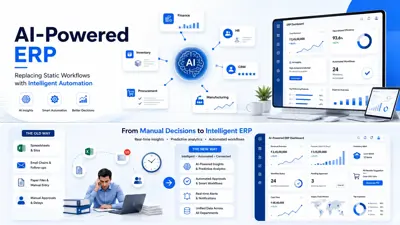
Key reality: Before adopting AI, businesses need to fix data discipline, standardize workflows, and clean up internal systems. This groundwork isn't glamorous, but it's what determines whether AI becomes an asset or an expensive disappointment.
Quick Checklist: Is Your Business AI-Ready?
- Customer and vendor data lives in one place, not five
- Invoices and accounting entries are entered consistently and on time
- Inventory records are updated in real time (or close to it)
- Documents and emails are searchable and organized
- Someone owns data quality as an ongoing responsibility, not a one-time cleanup
If you checked fewer than three boxes, focus on data and process cleanup before investing heavily in AI tools.
Where AI Actually Helps Businesses
Direct answer: Once the data foundation is solid, AI becomes a genuine multiplier automating repetitive work, surfacing insights faster, and supporting (not replacing) good decision-making.
This is the part most articles skip: AI does deliver real value just not the way the hype suggests. It's not a replacement for strategy or management. It's a force multiplier for businesses that already have their basics right.
| Use Case | What AI Actually Does | Who Benefits Most |
|---|---|---|
| Automated bookkeeping & reconciliation | Matches transactions, flags mismatches, reduces manual entry | Finance & accounts teams |
| Smart reporting & financial analysis | Turns raw numbers into readable summaries and trends | Business owners, CFOs |
| Customer support automation | Handles routine queries, routes complex ones to humans | Sales & support teams |
| Forecasting & trend analysis | Spots patterns in sales, demand, or cash flow | Operations & planning teams |
Pros of Adopting AI (With the Right Foundation)
- Cuts time spent on repetitive, manual tasks
- Surfaces trends humans might miss in large datasets
- Frees up staff for higher-value work
- Scales without proportional headcount growth
Cons or Risks (Especially Without Preparation)
- Unreliable output if data is messy or incomplete
- False confidence in AI-generated numbers or reports
- Upfront cost and time investment before ROI appears
- Requires ongoing human review it's not "set and forget"
Expert tip: Start small. Pick one process like invoice reconciliation or customer query routing clean up the data behind it, then automate just that. Expanding from a working pilot is far safer than automating everything at once.
Warning: Don't let AI-generated reports replace human judgment entirely, especially for financial or compliance decisions. AI supports decisions; it shouldn't make them unsupervised.
In short, AI works best as a multiplier, not a replacement, for good management.
AI Myths vs. Reality: A Quick Comparison
| The Myth | The Reality |
|---|---|
| "AI works instantly, no setup needed" | AI needs clean, structured data before it's useful |
| "AI replaces the need for good processes" | AI amplifies existing processes good or bad |
| "Bigger AI models always mean better results" | Model quality means little if the input data is poor |
| "AI adoption is a one-time project" | AI needs ongoing monitoring, correction, and updates |
Key Takeaways
- AI doesn't create value by itself it amplifies the data and processes already in place.
- Messy, scattered, or inconsistent business data leads to unreliable AI output.
- Before adopting AI, businesses should clean up customer, vendor, invoice, and inventory data.
- AI delivers real value in bookkeeping, reporting, customer support, and forecasting once the foundation is solid.
- AI works best as a multiplier for good management, not a replacement for it.
Final Thought
AI is not magic. It's a powerful tool but one that rewards businesses with discipline, structure, and clarity, and exposes those without it. The companies seeing real returns from AI aren't the ones with the flashiest tools. They're the ones that did the unglamorous work of organizing their data and processes first.
If you're serious about using AI in your business, the smartest first step isn't picking a tool it's fixing your systems.
Thinking about using AI in your business? Start by getting your data and processes in order. Talk to the Naapbooks team →