SEBI Board Meeting, March 2026
InsiderQ • SEBI Board Meeting • 5 min read
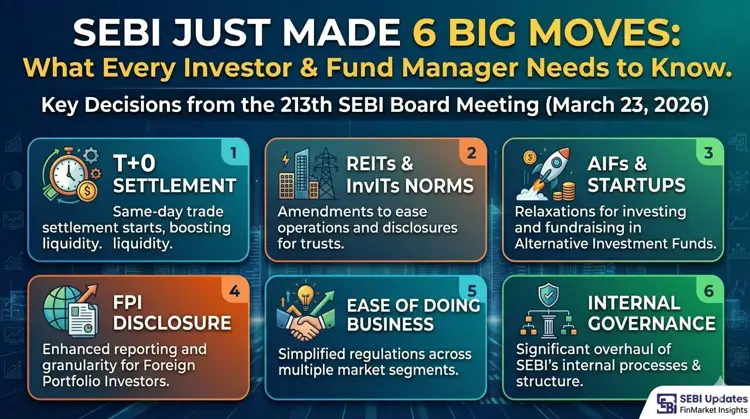
- 1.AIFs Get Breathing Room to Wind Up
- 2.Net Settlement Now Allowed for FPIs in Cash Market
- 3.Social Impact Fund Minimum Investment Cut from ₹2 Lakh to ₹1,000
- 4.InvITs and REITs: Four Operational Fixes
- 5."Fit and Proper" Criteria Overhauled for Market Intermediaries
- 6. SEBI Tightens Its Own Conflict-of-Interest Rules
- The Big Picture
The Securities and Exchange Board of India (SEBI) held its 213th Board meeting in Mumbai on March 23, 2026. The agenda was packed six major decisions covering everything from winding-up flexibility for Alternative Investment Funds to stricter conflict-of-interest rules for SEBI's own officials. Here's what each decision means in practice.
1. AIFs Get Breathing Room to Wind Up
Ease of Doing Business
Under the old rules, Alternative Investment Funds (AIFs) had to distribute all liquidation proceeds to investors and reach a zero bank balance before they could surrender their registration. Sounds clean in theory but in practice, many AIFs were stuck holding small amounts for pending tax demands, litigation notices, or lingering operational costs. They had to keep a live AIF registration (and comply with all its obligations) even when no fund management was actually happening.
SEBI has now fixed this by allowing AIFs to retain proceeds beyond the permissible fund life under three conditions: a demonstrable litigation notice or tax/regulatory demand has been received, at least 75% of investors by value have consented to cover anticipated liabilities; or operational expense amounts are substantiated by invoices or prior year comparables (max 3 years from end of fund life).
AIFs in this situation will be tagged as "inoperative funds" with a lighter compliance load: no periodic filings, no PPM updates, no performance benchmarking. They stay on SEBI's radar, but aren't burdened unnecessarily.
2. Net Settlement Now Allowed for FPIs in Cash Market
Ease of Doing Business
Foreign Portfolio Investors (FPIs) currently settle all transactions with their custodians on a gross basis meaning every buy and sell is settled separately, even within the same cycle. This racks up funding costs and creates foreign exchange slippage, especially on index rebalancing days when FPIs simultaneously buy incoming and sell outgoing index constituents.
SEBI has approved net settlement of funds for outright transactions in the cash market transactions where the FPI either buys or sells (not both) a security in a settlement cycle. The securities leg will still settle on a gross basis, and STT/stamp duty will continue to apply on delivery.
Simple example: An FPI buys Stock A worth ₹100 Cr and sells Stock B worth ₹100 Cr. Currently, it must fund ₹100 Cr for the purchase separately. After netting, the pay in for Stock A is adjusted against the sale proceeds of Stock B zero additional funding needed.
Non-outright transactions will continue on a gross basis, addressing market integrity concerns. Implementation deadline: December 31, 2026.
3. Social Impact Fund Minimum Investment Cut from ₹2 Lakh to ₹1,000
Retail Participation
This is a big one for retail investors interested in impact investing. The minimum investment in the Social Impact Fund (SIF) category of AIFs has been slashed from ₹2 lakh to just ₹1,000.
The move aligns the SIF minimum with the minimum application size for Zero Coupon Zero Principal (ZCZP) instruments under the SEBI ICDR Regulations, 2018. In effect, this makes Social Stock Exchange-listed instruments accessible to a much wider base of retail investors and brings mission-driven investing closer to everyday savers.
4. InvITs and REITs: Four Operational Fixes
Infrastructure & Real Estate
SEBI approved amendments to both the InvIT and REIT Regulations, 2014, addressing real-world operational friction. Four specific changes stand out.
Post-concession SPV holding: InvITs can continue holding a Special Purpose Vehicle (SPV) after its concession agreement ends - they now have 1 year to either exit or bring in a new infrastructure project, accounting for pending litigations and defect liability periods.
Broader liquidity options: InvITs and REITs may now invest idle cash in liquid mutual fund schemes with a credit risk value of at least 10 (AA and above), expanded from the earlier threshold of 12 (AAA only).
Private InvITs greenfield access: Privately listed InvITs can now invest up to 10% of assets in greenfield (under-construction) infrastructure projects - matching the flexibility already available to publicly listed InvITs.
Borrowing flexibility: InvITs with leverage between 49–70% of asset value can now use fresh borrowings for capex, major road maintenance, and refinancing existing debt (principal only) - not just acquisition/development as before.
5. "Fit and Proper" Criteria Overhauled for Market Intermediaries
Intermediary Regulation
SEBI has revamped the "Fit and Proper Person" criteria under the Intermediaries Regulations, 2008, balancing market integrity with ease of doing business. Key changes: a pending FIR or criminal complaint filed by SEBI, by itself, will no longer be automatic grounds for disqualification; disqualification for moral turpitude conviction is expanded to cover any economic offence or offence under securities laws; initiation of winding-up proceedings is removed as a standalone disqualification trigger; intermediaries must inform SEBI within 15 working days of any relevant event affecting KMPs or persons in control; a hearing must now be given before declaring someone "not fit and proper"; the default 5-year bar on fresh registration has been removed; and the non-consideration period after a Show Cause Notice has been shortened from 1 year to 6 months.
6. SEBI Tightens Its Own Conflict-of-Interest Rules
Internal Governance
Perhaps the most talked-about agenda item - SEBI considered the recommendations of a High-Level Committee (HLC) set up to review conflict-of-interest and disclosure norms for its own Board Members and employees.
Approved without modification: Chairman and Whole-Time Members (WTMs) are now subject to the same investment and trading restrictions as employees; equity investments in commercial ventures must be liquidated or frozen during tenure; Chairman and WTMs are brought within the definition of "insider"; the definition of "family" has been aligned for Members and employees; Members and employees must disclose any future employment negotiations; and a digital whistleblower system and ethics training programmes will be established.
Approved with modifications: Immovable property details of senior officials (Chairman, WTMs, EDs, CGMs) will be publicly disclosed in line with AIS/CCS officer norms; a new Office of Ethics and Compliance (OEC) will be established under the Chief Vigilance Officer; direct share investment restrictions will extend to spouses and dependent family members (existing investments grandfathered); and no SEBI official can have more than 25% of their financial portfolio in products managed by a single SEBI-registered intermediary.
Two recommendations - notifying separate regulations for Board Members and creating an external Oversight Committee on Ethics and Compliance - were referred to the Central Government for a decision.
The Big Picture
The March 2026 SEBI Board meeting was heavy on ease-of-doing-business reforms - fixing practical bottlenecks for AIFs, FPIs, InvITs and REITs that have accumulated over years. At the same time, the internal governance overhaul signals SEBI's intent to hold itself to the same standards it expects of market participants. For investors and fund managers, the changes around AIF wind-up, FPI net settlement, and InvIT borrowing flexibility are the most immediately impactful to watch.
Source: SEBI Press Release PR No. 18/2026, March 23, 2026. This is for informational purposes only and does not constitute legal or investment advice.